


Call a dentist promptly if a tooth breaks or a filling falls out. Austral Smiles assesses broken teeth and lost restorations, with same-day urgent appointments where possible. Call to check availability. If you have trouble breathing or swallowing, or heavy mouth bleeding, seek emergency medical care instead of waiting for a dental booking.
You might be holding a small piece of something and wondering whether it's tooth or filling. You don't have to work that out before calling. Describe what happened, how you feel and what you've noticed. This guide helps you prepare for that conversation and your visit.
What should you do when a tooth breaks or a filling falls out?
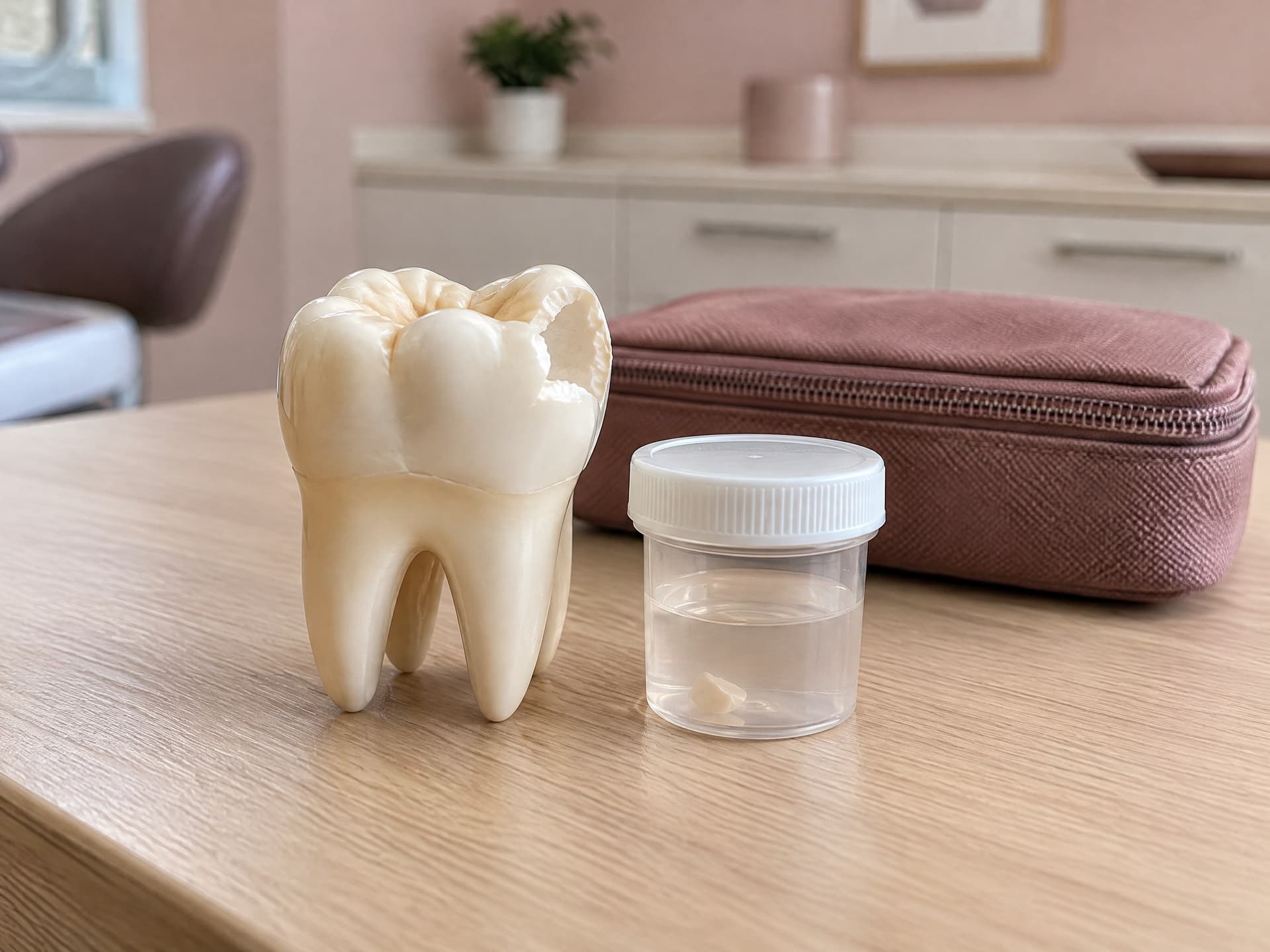
AI-generated illustration: an enlarged teaching model represents a chipped tooth.
Contact a dentist for an assessment. The Queensland Government's emergency dental guidance, updated in March 2022, says: If a tooth is chipped, fractured or cracked, seek dental treatment as soon as possible.
Tell the team what happened and what you've noticed, rather than trying to choose a repair before the tooth has been examined.
When to seek medical help first
Call triple zero (000) or go straight to the emergency department if you're having trouble breathing, talking or swallowing, a lot of blood is going down your throat, or your mouth or tongue is very swollen. These are the urgent-care signs in healthdirect's dental injury guidance. Don't wait for a clinic opening time or an online booking response.
For tooth pain, a broken edge, a lost filling or swelling around a tooth, call Austral Smiles about an emergency dental appointment. Tell us about swelling, persistent pain, bleeding or a recent accident when you first speak to the team. A jagged edge can irritate your tongue or cheek, so mention that too.
On a phone, swipe the table sideways to see both columns.
| What you've noticed | What to do next |
|---|---|
| Breathing or swallowing difficulty, very swollen mouth or tongue, or a lot of blood going down your throat | Call 000 or go straight to the emergency department. |
| A cracked, chipped, loose or missing tooth after an accident | See a dentist. Describe the accident and any bleeding, swelling or difficulty opening your mouth. |
| A lost filling, broken restoration or sharp tooth edge | Contact the clinic promptly and explain whether the tooth hurts or the edge is injuring your mouth. |
| Pain that persists or swelling around a tooth, cheek or jaw | Tell the team when calling. These symptoms need dental assessment. |
Use this table to describe the problem, rather than to diagnose it yourself. If your symptoms change after you've booked, call again and explain what's different.
Should you bring the broken piece?
Bring a broken tooth fragment if you have it. Healthdirect advises placing the piece in milk or sterile saline solution and taking it to the dentist. Tell the team what you found and how you've stored it. Keeping the fragment is a preparation step, not an assurance that it can be put back.
A whole adult tooth knocked out of its socket is different from a chipped corner or missing filling. It needs urgent dental or hospital care. If that's what has happened, call immediately and say that the whole tooth is out; don't describe it simply as a lost filling. Ask for immediate instructions rather than following a routine booking process.
You may not have found a piece at all. Say that when you call. You can also explain whether the gap appeared during a meal, after a fall or at another time. You don't need a photograph or the original fragment to start that conversation.
How can you look after the area before you're seen?
For a dental injury, healthdirect recommends applying pressure with a clean towel or dressing to help stop bleeding, using a cold compress against the face for swelling, and eating soft foods. Wrap an ice pack in a cloth before placing it against your skin. Heavy mouth bleeding needs urgent medical care.
Ask the clinic for advice about your particular tooth while arranging the visit. A damaged filling can leave the tooth exposed, and a sharp edge can irritate nearby soft tissue. Our dental fillings information explains the role of fillings in damaged teeth; it can't establish what your tooth needs without an assessment.
If you're considering a home repair product, ask the dentist about it rather than choosing a treatment from an internet description. Tell the team about anything you've already used, including a temporary repair material or medicine, and bring its name or packaging details.
There isn't a waiting period in this guide that you can apply to every broken tooth or lost filling. Ask the dental team about timing based on your symptoms. An appointment-preparation checklist shouldn't be used to decide that waiting is suitable for you.
What should you say when you call Austral Smiles?
Start with what happened and the symptoms you're experiencing now. You can use this script and change it to fit your situation:
"A piece of my tooth or filling came out at about [time]. It's on the [side] of my mouth. I have [describe pain, swelling or bleeding], and [say whether there was an accident]. I have [or haven't] found the piece. Can you advise what I should do and arrange an assessment?"
Use your own words. If you're uncertain about a detail, say so. "I'm not sure whether it's tooth or filling" is useful information too.
Austral Smiles offers same-day appointments for urgent needs where possible. Availability needs to be checked by phone; an emergency appointment isn't an automatic same-day booking. The clinic's emergency page also confirms that we're open until 7 pm on Tuesdays.
Before ending the call, check the appointment time, what you should bring and how to contact the clinic if anything changes. If you're worried about the cost, say that at the start so you can ask about the assessment and treatment-planning process.
What should you bring to the appointment?
Bring the details the team needs to understand your health and organise your visit. Austral Smiles' new patient information asks you to arrive 10 minutes early, bring your private health fund card or Medicare card if using CDBS, and let the team know about accessibility needs or specific concerns in advance.
- Bring any broken tooth fragment, stored in milk or sterile saline as advised by healthdirect.
- Have a list of current and previous medicines, including medicines bought without a prescription, vitamins and supplements.
- Be ready to discuss allergies, medical conditions, recent hospital care and whether you're pregnant or breastfeeding.
- Tell the team about dental anxiety and any concerns about having treatment.
- Bring your private health fund card, or Medicare card if using CDBS.
- Write down what happened, when it happened and the questions you want to ask.
The Australian Dental Association's medical history guidance, checked for this article in November 2026, explains why these details belong in a dental visit. If your medical history is complicated, it suggests bringing a copy of your medical history or medicine list from your doctor. You don't have to rely on memory while you're worried about your tooth.
If breastfeeding is relevant to your visit, our guide to breastfeeding and dental treatment has questions to raise with the team. Tell us your circumstances rather than assuming advice for someone else applies to you.
What happens at an emergency appointment?
The emergency visit begins with assessment. Austral Smiles' published process says the dentist listens to your concerns, examines the area and may take X-rays. Treatment then focuses on stabilising the concern and relieving pain, followed by aftercare instructions and a follow-up booking where further care is needed.
- Explain what happened and the symptoms you've noticed. The dentist examines the area and may use X-rays to assess the problem.
- Discuss the treatment needed for the immediate concern. The clinic lists a temporary filling or reattaching a dislodged crown among possible emergency measures.
- Check the aftercare instructions and whether another appointment is needed.
Austral Smiles also explains that your dentist discusses the findings and options and provides a clearly itemised treatment plan before starting the procedure. Ask about anything you don't understand. A useful question is: "What are we doing today, and what decisions will I need to make afterwards?"
Why might the emergency filling be temporary?
A temporary filling can be part of emergency care rather than the final restoration. The Australian Dental Association's fillings guidance, checked in November 2026, says dentists may use a temporary filling during emergency treatment, when there isn't enough time to finish treatment in one visit, or when a tooth needs care across several appointments.
The ADA also explains that the location of the tooth, how the teeth bite together and the size of the filling influence the choice of filling material. Losing a filling doesn't tell you which replacement material is appropriate. Ask your dentist what the examination shows and what the next stage involves.
A broken tooth may need different care from a straightforward replacement filling. Healthdirect says a cracked or broken tooth may need a crown, while an injury to the tooth's inner pulp may need root canal treatment. These are possibilities to discuss after assessment, not a diagnosis or recommendation for your tooth.
Before leaving, ask: "Is today's treatment temporary? What follow-up do I need? What symptoms should make me call sooner?" Write the answers down if you're likely to forget them once you get home.
How can you prepare for the cost discussion?
Ask about the assessment first, then the proposed treatment and any later visits. Austral Smiles' payment information says general pricing can be discussed over the phone, but a detailed quote is available only after consultation. That quote includes item numbers and estimated costs based on your clinical needs.
If you have private cover, ask for the item numbers so you can check your benefits with your fund. The clinic's patient policy explains that rebates and out-of-pocket costs vary with treatment, cover, benefit limits and waiting periods. Don't assume the amount your fund paid for a previous filling will apply to this visit.
You can ask: "Does this estimate cover today's care only, or the follow-up too? Which costs are still to be confirmed?" That keeps the conversation focused on your actual plan, rather than a general filling price you found online.
Arrange your Austral Smiles visit
Call (02) 9053 1997 and tell the team you have a broken tooth or lost filling, when it happened and whether you have pain, swelling or bleeding. Ask about the next available assessment and what to bring. Same-day urgent appointments are offered where possible, so please call to check availability.
You can also use the Austral Smiles appointment page for booking arrangements. For an urgent concern, use the phone to explain your symptoms. If you have the emergency medical signs described above, call 000 or go straight to the emergency department instead.
Sources
Sources checked 2 November 2026. This article summarises general published guidance and the clinic's appointment information; it isn't personal dental advice.
- Queensland Government: Emergency dental, updated 16 March 2022. Quotation © The State of Queensland 2026, used unchanged under CC BY 4.0; see the Queensland Government copyright notice.
- Healthdirect: Dental injury, last reviewed February 2026.
- Australian Dental Association: Dental fillings and medical history guidance; no publication dates displayed.
- Austral Smiles: emergency care, fillings, new patient information, payment information and patient policy.
Photos in this article are AI-generated illustrations, not photos of Austral Smiles, its staff or patients.